On the Sunny Side of Swing

Ana Piérola. 19 October 2020

Swing music was born in the United States during the 1930s and shook up the ballrooms all across the country. Nowadays it is still playing for the international Swing Dance Community, but was it all the rage just in the past century? Is it only a retro trend? Or is it possible that Swing is more alive than ever?

The Whitey's Lindy Hoppers performing in the film ‘Hellzapoppin'’ (1941)

Swing has come to our time as dance studios and festivals all around the globe. From the end of the Roarin’ 20s in Harlem (New York City), stepping its way through Hollywood , it has reached the hearts and feet of several generations of dancers. Charleston, Lindy Hop, Balboa, Shag, Blues… they all came to stay with a good dose of modernity. .

A walk on the sunny side of the street

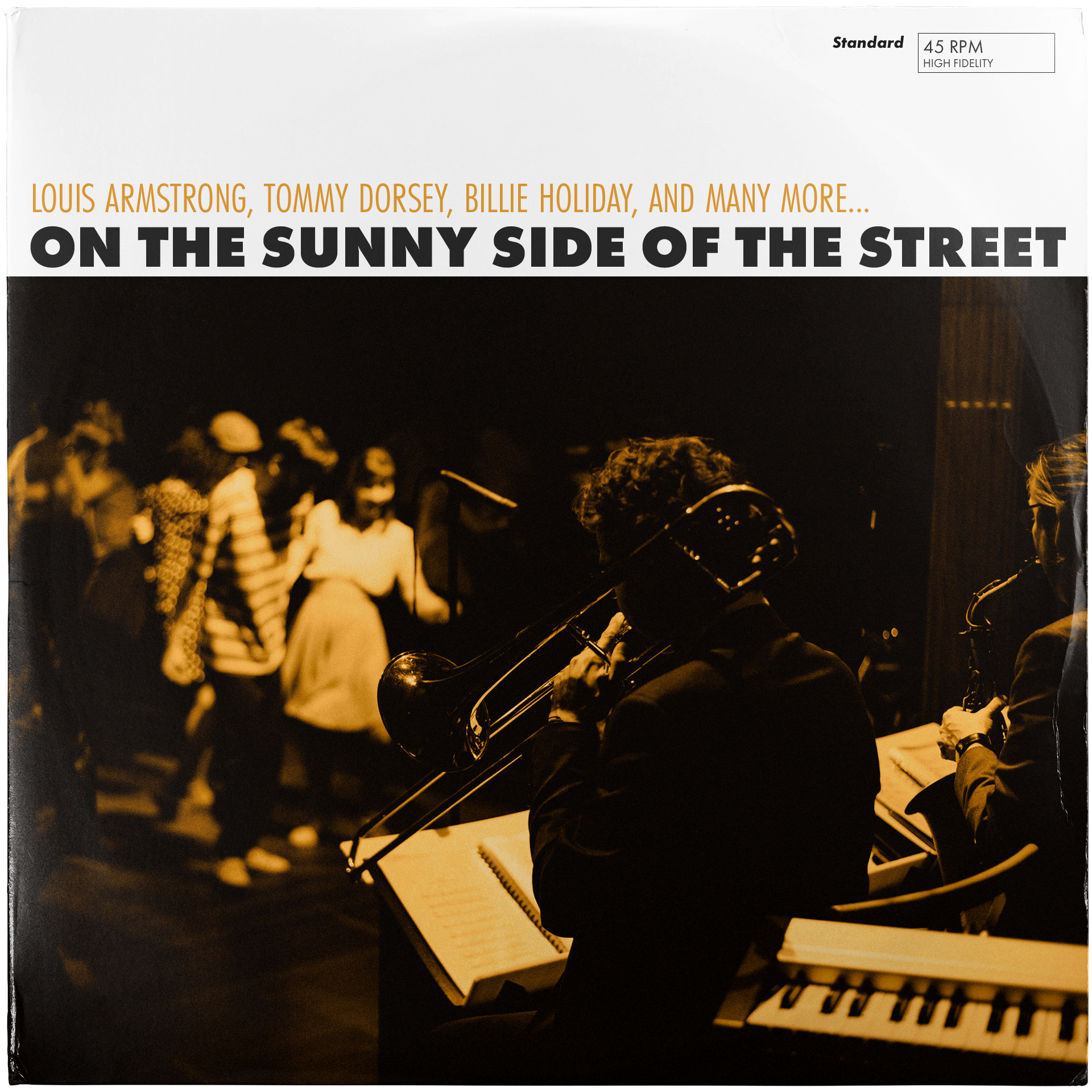
Curiously enough, in June 2020, the tune ‘On The Sunny Side Of The Street’ turned out to be the most popular song in an open survey for members of the Swing Dance Community. With a sweet melody and a danceable rhythm , it is a delight for both novel and experienced dancers.

In this article, I am going to show you what an iconic tune such as ‘On The Sunny Side Of The Street’ can tell us about the history of Swing.

STOP

Keep scrolling down...

Tommy Dorsey Part 2

Popularity

28

Released in

1938

Tommy Dorsey
Sample not available 1 9 3 0 1 9 4 0 1 9 5 0 1 9 6 0 1 9 7 0 1 9 8 0 1 9 9 0 2 0 0 0 2 0 1 0 2 0 2 0

On The Sunny Side Of The Street

Written in 1930, with lyrics by Dorothy Fields and music by Jimmy McHugh.

It was first performed in February 1930 in the musical show:

Lew Leslie's International Revue

The origin. Ted Lewis was the first artist to record it, together with his orchestra in 1930 , before Harry Richman did on the same year . Louis Armstrong recorded it for the first time in 1933   and released his most popular version of the tune in 1961 . How many versions of ‘On The Sunny Side Of The Street’ can you think of?

Versions. Since 1930, this song has been performed and recorded by more than 1.400 artists. Some Swing tunes were written during the early peak of the genre and have been performed and recorded for almost a whole century, thus producing a myriad of versions of the same tune. However, we may wonder how many exactly. And when?

Spotify. Spotify’s catalogue offers an incredible collection of 2.658 songs with this title, including versions by 1.479 artists since 1930. This database provides different kinds of information: who recorded the song, the name of the album, when it was released,… and much more.

The result. When it comes to Swing music, the initial expectation might be to find original tunes from the 30s, 40s and 50s followed by modern versions and some new songs. However, the data has turned out to be more than surprising: maybe Swing is not only the 20th-century rage that one may think.

How to read

This chart shows the distribution of all the versions of ‘On The Sunny Side Of The Street’ that are available from Spotify.

The outer band contains the songs.
The middle band indicates the decade when they were released
The inner circle shows the information for each song.

The songs are arranged in decades , clockwise from the top.

The width of each song represents its popularity according to Spotify.


Hover over each song in the record to read its information. Click to listen to a sample of each song.

Use the filter to sort the songs by:

  Spotify popularity (↓)

  Artist (A-Z)

  Release year (↑)


Keep on swingin'

No more and no less than 88% of the songs n Spotify’s catalogue have been released in the 21st century. With 90 years of history behind them, some of these versions are first releases, whereas others are remastered releases or new releases of an older recording.

The International Federation of the Phonographic Industry (IFPI) collects and publishes a database of music recordings. Up to the date of the current analysis, IFPI has published 1.600 unique recordings with the title ‘On The Sunny Side Of The Street’.

The evolution of ‘On The Sunny Side Of The Street’, from 1930 until today

1940 1950 1960 1970 1980 1990 2000 2010 2020 1930 0 200 600 1000 400 800 Recorded or remastered songs Released songs

As it also happens in Spotify’s catalogue, 89% of the songs in IFPI’s database have been released in the 21st century. What’s even more surprising? 81% of the songs have been produced in the 21st century.

The origin of the songs, decade to decade

The horizontal axis indicates the recording (or remaster) date of songs with this title. The vertical axis indicates the release date of songs with this title. The bubbles represent the number of songs that have been recorded (or remastered) in the decade that indicates the horizontal axis and released in the decade that indicates the vertical axis. 500 200 50 5
2000 2020 2010 1990 1980 1970 1960 1950 1940 1930 2000 2020 2010 1990 1980 1970 1960 1950 1940 1930 When the songs were recorded/remastered When the songs were released

Although there is less information about the music industry during the first decades, the original recordings from the Swing Era (between 1930 and 1950) have been re-edited up until today, especially during the last decades. However, they represent only 10% of the songs released during the 21st century, as opposed to 74% of songs recorded or remastered since the year 2000.

This trend appears in the 90s, when the recordings from the Swing Era are first re-edited. In fact, 35% of the releases in the 90s are original recordings from the 30s, 40s and 50s.

Before this, 100% of the songs released in the 1960s and 1970s had been produced in the same decade.

Rock & Roll dance scene from the film ‘Don't Knock The Rock’ (1956)

The world kept spinning around while we walked on the sunny side of the street

The Golden Swing Era took place during the 1930s and 1940s. After the end of World War II, new styles appeared and replaced Swing on the dance floors. Above all, Rock & Roll was born . During the 1960s up to the 1980s, Swing lived its lowest time, until the Swing Revival of the 1990s, when it even took part in big cinema productions like Swing Kids and Malcolm X . Later, during the 2010s, the digital revolution of the music industry matches the biggest increase in the number of songs.

Anna and Jonathan performing to the sound of Le Dancing Pepa's ‘Honeysuckle Rose’ at Move Your Bottom (Valencia, 2020)

Makes no diff'rence if it's sweet or it's hot

This article is the result of a research study about the most loved Swing tunes for nowadays dancers. According to the survey that began this study, ‘Honeysuckle Rose’ is also one of the most popular songs in the Community today .

Written by Fats Waller in 1927, ‘Honeysuckle Rose’ represents, together with ‘On The Sunny Side Of The Street’ one of the faces of Swing dancing. With a happy unmistakable melody, these songs are a classic that one may find either in an Ella Fitzgerald and Louis Armstrong compilation or a light jazz album to play at dinner .

Nonetheless, nine decades have given us plenty more to choose. As Ella Fitzgerald used to sing in the tune that Duke Ellington wrote in 1932, ‘It Don't Mean A Thing (If It Ain't Got That Swing)’ . We still sing to this anthem at the end of the party well into the 21st century .

Last but not least, in the search of the most iconic Swing tunes, it is impossible to forget the call to the jam circle, when the band invites everybody to gather around, and its definite tune: ‘Jumpin' At The Woodside’ . This tune, written by Count Basie in 1938, still makes the peak of a great Swing party .

The revival phenomenon that ‘On The Sunny Side Of The Street’ has seen throughout the years is not a rare, one-off case. The production and distribution of the greatest hits of Swing go beyond its sweetest and sunniest side.

STOP

Recorded or remastered songs

Released songs

H o n e y s u c k e R o s e , 1 9 2 9 O n T h e S u n n y S i d e O f T h e S t r e e t , 1 9 3 0 I t D o n ' t M e a n A T h i n g , 1 9 3 2 J u m p i n ' A t T h e W o o d s i d e , 1 9 3 8 1930 1940 1950 1960 1970 1980 1990 2000 2010 2020


Acknowledgements

This article is a result of my Master's Thesis for the 2019-2020 edition of the Online Master in Information Design and Data Visualisation at Shifta by Elisava (more info here).

I would like to thank my professors Driss Abrouk, Ferran Caymel and Paadín for their guidance and support in this project.

Also, Ania Gadar, for letting me use one of her beautiful pictures.

Finally, my cat, for keeping me company during the process :-)

Methodology

In July 2020, I launched an online open survey for the Swing Dance Community about their music tastes and habits. I got the answer of 64 members of the Community who shared one of their favourite Swing tunes and a Spotify playlist of songs for dancing.

10 out of the 64 respondents chose ‘On The Sunny Side Of The Street’ as their favourite tune. Furthermore, it is the second most popular title in the playlists with 28 songs, only outnumbered by ‘Honeysuckle Rose’ (29).

I collected the information about musical releases and recordings shown in this project from Spotify’s API and IFPI’s database. Although Spotify provides the release and copyrights dates of their published songs, this data does not necessarily match the recording date in every song. For this reason, I turned to the database that IFPI offers through their website, where musical recordings are uniquely identified by an alphanumerical code (ISRC).

I found some limitations in the data. I have discarded songs with missing values in the release and/or recording date fields, as well as later recording dates with earlier release dates. Although IFPI’s catalogue includes album, single, live and remastered versions, the classification is not complete in this regard.

The processing of the data includes cleaning and unifying artist names, removing equivalencies and redundancies such as and, And, &, her/his orchestra, etc.